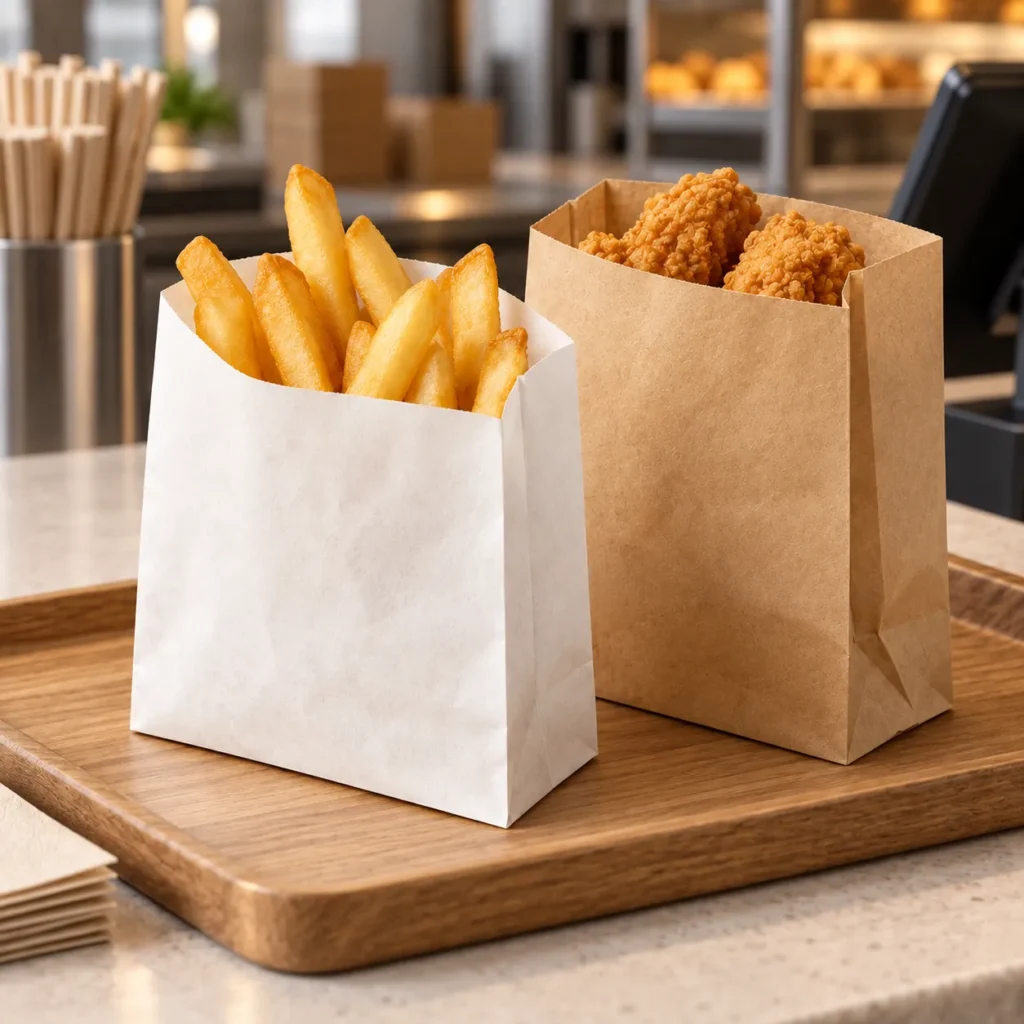
Coordinate the meal, wrap, bag and carrier
Quick-service restaurants, distributors and private-label brands often purchase multiple paper formats together. The outer carrier, the food wrap and a serving liner do different jobs; one paper structure rarely suits every contact and transport requirement.
Work backward from the packed meal: what touches food, what holds the weight, what traps steam, and what faces oil or sauces? The answer determines the right questions for each packaging component.
Compare the key paper packaging formats
| Product | Primary function | Specification to agree |
|---|---|---|
| Grease-resistant snack bag | Hold oily or dry handheld food | Food type, grease exposure and contact time |
| Burger and sandwich sheet | Wrap and present individual portions | Sheet size, folding behavior, barrier and print side |
| Food tray or basket liner | Presentation and tray cleanup | Tray geometry, grease conditions and service duration |
| Kraft takeaway carrier | Transport packaged food units | Fill weight, handle design and bottom footprint |
What drives test and sampling requirements?
For a loaded paper carrier, the key concern may be handle attachment and lifting conditions; for a wrap, it may be oil exposure, foldability or how a printed surface contacts food. Specify acceptance tests with the factory instead of assuming a blanket ‘leakproof’ or ‘food-grade’ claim.
Food-contact compliance depends on the finished material structure and the destination market. Coating, inks, adhesives and actual conditions of use can change what evidence is required.
- Run a filled-package trial at the intended meal weight and packing time.
- Separate dry carry requirements from wet or high-grease service.
- Identify any heating, refrigeration or microwave exposure separately.
- Review print artwork, carton counts, samples and traceability before release.
Make supplier quotes comparable
A low piece price can be misleading when dimensions, grammage, barrier structure, printing coverage and packaging quantities differ. Ask suppliers to quote against the same dimensional drawing and agreed performance requirements, then compare approved samples.
Food paper bags ↗ · Burger wraps ↗ · Tray liners ↗ · Carrier bags ↗
Buyer questions worth resolving
Does PE-coated paper always replace grease-resistant paper?
No. Evaluate the full structure against the food type, barrier target, print design, disposal requirements and any food-contact rules.
Can one carrier work for all meal weights?
Not without checking the filled load, handles, reinforcement and performance under the intended carrying conditions.
Prepare a useful sourcing brief
A clear inquiry gives a supplier the intended use, format, material and testing questions—not just a target price. Include your destination market, drawing or sample, print design, order forecast and acceptance criteria.
Build a local RFQ worksheet ↗ · Review quality documentation ↗