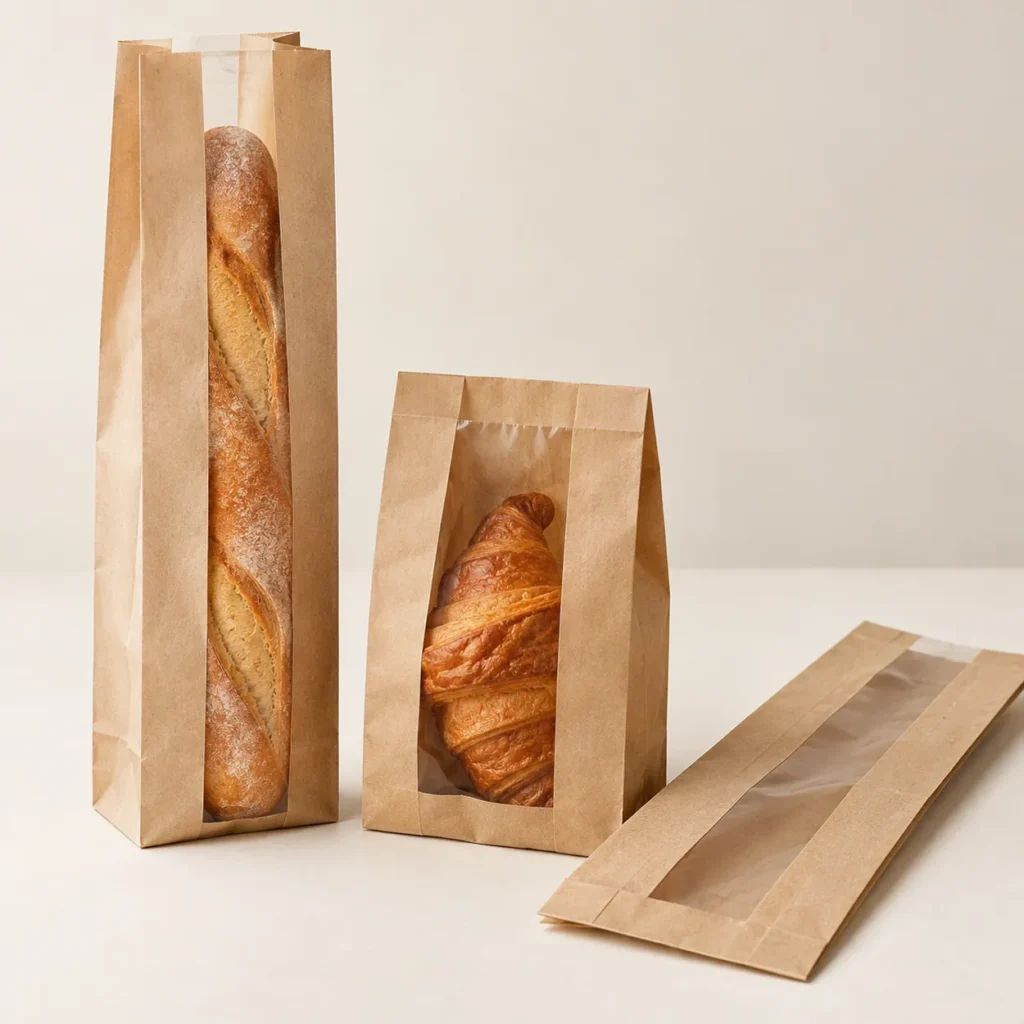
A bakery bag is more than a printed paper sleeve. Bread dimensions, temperature at packing, ventilation and retail display all shape the best format. Buyers should define those details before approving artwork or comparing supplier quotes.
1. Choose dimensions based on the baked product
Long baguettes, round loaves and delicate pastries may need different bag proportions and openings. Measure the product after cooling and allow space for handling without unnecessary loose material. Confirm width, height, side gusset, folded bottom and dimensional tolerance.
2. Decide whether a window is genuinely needed
A display window may support retail merchandising, but it introduces a different material and joining step. Treat window size, placement, film type and adhesives as a technical proposal rather than an automatic standard feature. If a buyer prefers a paper-only format, state that in the brief.
3. Consider moisture, cooling and storage
Warm bakery products can release moisture inside packaging. Depending on the food and storage conditions, a window, lining or closure may change ventilation and appearance. Claims about preserving crispness or extending shelf life require testing with the real bakery product; packaging photography cannot establish performance.
4. Prepare professional print artwork
Provide vector files and branding references. Specify whether printing is on one or more sides, approximate print coverage and any special finishing. Discuss proof approval and paper color, since print appearance can change with natural-kraft versus white substrates.
5. Confirm food-contact requirements
Identify the destination market and food-contact scenario. The printed side, inks, paper substrate, film and adhesive, if present, may have different documentation needs. Request records relevant to the exact finished product rather than unrelated generic certificates.
6. Approve a real sample and packing plan
Check how the bag opens, fills, stores and presents the food. Record agreed dimensions, material, color and any performance criteria. Confirm pack quantities, carton weight, export labels and commercial terms before bulk production.
Copy-ready questions for a bakery bag supplier
- What dimensions and paper weights can be made for my product?
- Is a display window technically feasible for the intended use?
- What proof and sample approvals are available?
- How will the printed construction be evaluated for food contact?
- How are MOQ, lead time and delivery packing determined?
Review bakery paper bag concepts and custom packaging development for more information. Manufacturing options remain subject to specification review.
Packaging selection: bakery product behavior drives the format
An approval sample should be assessed while the actual product is inside the bag. A long baguette, a warm pastry and a boxed cake require different fill geometry. Decide whether the product will be hot, cooled, oily or moisture-releasing during the expected holding period before choosing paper and printing.
| Buying situation | Specify first | Question before approval |
|---|---|---|
| Long bread or baguette | Actual length, diameter, opening and gusset | Does staff fill the product without compression or snagging? |
| Fresh warm pastries | Fill temperature and expected moisture exposure | Will condensation or handling change the bag’s suitability? |
| Windowed retail bread bags | Window material, printed side and adhesives | What additional documents are needed for the final construction? |
| Brand-printed counter bags | Print area, ink colors, folds and approved art | Does the print remain legible in the filled or folded form? |
Scenario: same bakery brand, two uses
A bakery selling crusty bread at the counter and oily pastries for takeaway may want a consistent appearance. The paper structure and barrier may still require different acceptance tests. Separate common artwork from the application-specific product specification, and approve both physical bag formats before combining purchase volumes.
Further buyer questions
Does a viewing window preserve freshness?
A window allows product visibility, but does not alone establish extended shelf life, crispness or moisture performance.
Can the bakery bag go in an oven or microwave?
Do not assume heating suitability from the paper appearance. Such uses require construction-specific tests and evidence.
Continue your sourcing research
This article offers general procurement guidance, not a guarantee of particular manufacturer capability or compliance. Confirm requirements, materials and tests against a written specification.