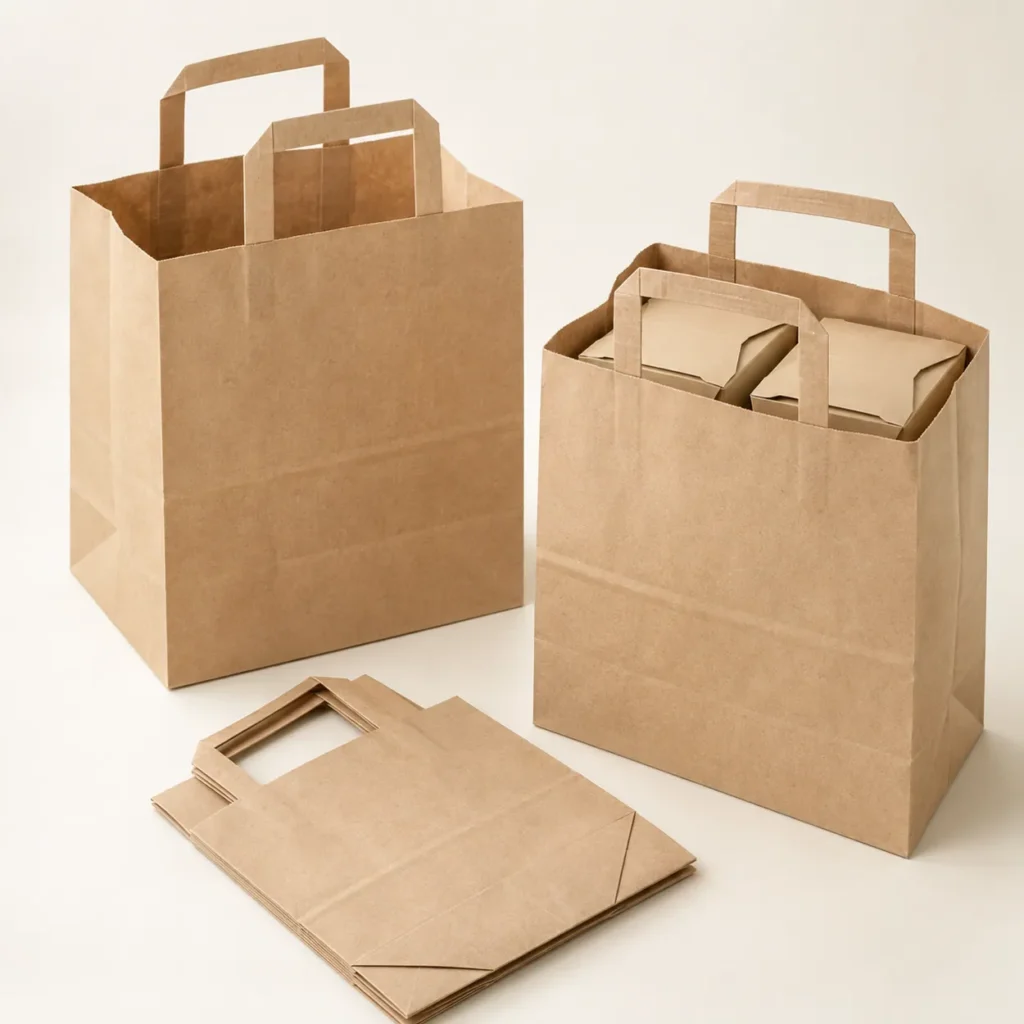
Custom-printed paper bags can make a food brand recognizable across takeaway orders and retail displays. To get a reliable quotation and avoid repeated production changes, buyers should prepare more than a flattened logo screenshot. Flexographic printing workflows depend on printable material, colors, artwork positioning and production requirements.
Start with editable vector files
Ask your designer for an editable vector file such as AI, EPS or a production-ready PDF with text and lines converted appropriately. Supply any brand guidelines and a clearly labeled reference image. Raster artwork may be useful as an example, but may not be sufficient for plate preparation at the intended print size.
Define the actual paper and print area
Print appearance differs between natural-kraft and white paper. Surface texture, porosity, coating and bag construction can also change the achievable result. State the bag dimensions, gusset, handle location, panel layout and print direction. Obtain the factory’s printable-area guide before finalizing the artwork.
Agree the color system and tolerances
Specify spot colors or another documented reference where required. A screen image is not a reliable print-approval standard. Buyers should request a proof reflecting the proposed substrate and process, and discuss whether a physical sample or color drawdown is necessary.
Consider seams, folds and edge allowances
Design elements close to bag folds, gussets or seals can disappear or become distorted. Important barcodes, legal information and small text should not be placed in areas prone to creasing, cropping or print variation. The converter should identify required tolerances.
Ask about the ink system and intended application
For food packaging, the intended food contact and print orientation can affect the ink and structure review. Do not assume any given printed paper is food-contact compliant because its unprinted base material has a test report. Confirm the final printing and converting construction against the destination’s requirements.
Proof and sample approval checklist
- Editable logo/artwork source and brand color references
- Finished bag dimensions and unfolded artwork template
- Material grade, gsm and coating information
- Number of colors, printed sides and repeat details
- Review of barcode readability, orientation and legal text
- Approved print proof and physical sample when appropriate
Explore custom takeaway paper carrier concepts, bakery bags, and the custom packaging process. Final production artwork and printing capabilities require factory approval.
Print approval: what the production team needs to confirm
Flexographic packaging design must be approved on the intended paper structure, not only on a digital screen. An artwork PDF can establish layout, but bag folds, plate repeats, natural kraft shade and print-side orientation influence how a finished sample appears. Ask whether the supplier uses an approved physical proof, color reference, press drawdown or another agreed approval method for the proposed order.
| Approval input | Buyer should provide | Supplier question |
|---|---|---|
| Brand artwork | Editable vector logo, text, fonts and reference colors | What file format, trapping and line minimum are acceptable? |
| Printed surface | White/kraft paper, coating side and intended food-contact surface | Is this ink system suitable for the agreed use and final construction? |
| Repeat and fold lines | Dimensioned dieline, flat size, seam and gusset positions | Will key text or graphics cross a fold, handle or glue seam? |
| Color approval | Agreed visual target and tolerance at production stage | How does the paper shade affect color and proof comparison? |
Scenario: one design across several bag sizes
A café may order a small pastry bag and a larger takeaway carrier with the same brand artwork. Keeping logo proportions identical on the screen is not enough: each bag should have an approved printable area and print repeat. Check whether the plates, film or art placement change, and retain size-specific proof revisions for later orders.
Further buyer questions
Does an approved digital mock-up guarantee the press result?
No. Substrate color, dot reproduction, folds and press conditions may affect the final product. Agree the approval reference and what deviations are acceptable.
When might artwork need a new approval?
A change to paper shade, dimensions, print surface, number of colors, language, regulatory text or fold geometry may require reapproval.
Continue your sourcing research
Materials and printing fundamentals ↗ · Sample approval checklist ↗
This article offers general procurement guidance, not a guarantee of particular manufacturer capability or compliance. Confirm requirements, materials and tests against a written specification.