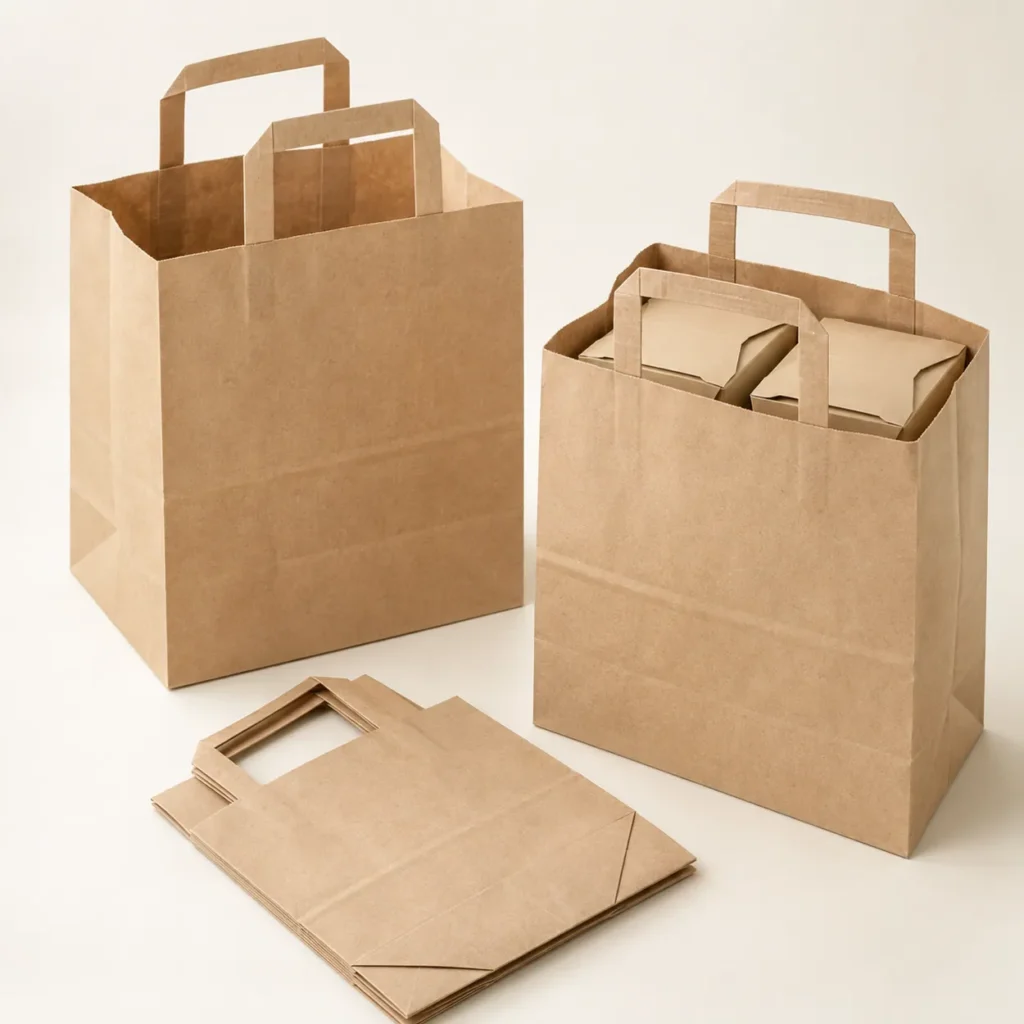
When a buyer asks several factories to quote for the same paper bag, the prices are only useful if the specifications are comparable. A bag that looks similar in a photograph can use a different paper weight, barrier treatment, print process, handle construction or packing method. This checklist helps purchasing teams prepare a clear request for quotation (RFQ) and avoid assumptions.
1. Describe the application before the bag
Start with what the packaging must do: hold hot takeaway food, display baked goods, carry meal boxes, collect dry passenger waste, or meet a specific airline specification. State the filling conditions, time in contact with the contents, expected handling and target country. Food-contact and transportation requirements are application-specific; they should not be inferred from a product name.
2. Provide a technical drawing or reliable dimensions
For a carrier bag, state width, side gusset, height, bottom construction and handle requirements. For a flat sheet, give the sheet dimensions and tolerances. For an airsickness bag, show the opened and folded size, target capacity and closure design. If you do not have a drawing, send photographs alongside a measured physical sample and clearly identify which measurements are estimates.
3. Define material and barrier requirements
Ask the supplier to quote the base paper separately from any coating or barrier structure. Provide known grammage, finish and performance needs. Do not assume a coating is biodegradable, plastic-free or suitable for every food: ask for evidence matching the exact final construction and market.
4. Include printing and artwork
Attach editable artwork, specify the number of print colors, printed sides, repeat layout and brand color references. Confirm who supplies proofs and how colors are approved. Some projects need a production print proof rather than a digital screen preview.
5. State quantity, packing and destination
Provide a trial order quantity and annual forecast if available. Mention how the product must be packed, labeled and palletized. For export quotations, state the destination port and requested Incoterm so shipping assumptions can be discussed separately from the unit price.
6. Confirm samples, tests and acceptance criteria
Ask which characteristics will be tested, what evidence will be supplied and who approves the golden sample. Clarify dimensional tolerance, barrier tests, carrying-strength conditions and the treatment of non-conforming goods. Buyers should confirm required certification and inspection documents before committing to an order.
A copy-ready RFQ checklist
- Buyer and destination country
- Product category and intended use
- Technical drawing / width, height, gusset and tolerances
- Base paper, grammage and coating/barrier requirements
- Food-contact or other compliance needs
- Artwork, color count and printing requirements
- Estimated quantity and annual volume
- Export packing, destination and shipping term
- Sample, performance test and quality acceptance expectations
Next step: Review the paper packaging collection, or send your completed specification to the Jinxiang sales team after contact details are confirmed. Any final capability and quotation must be approved by the factory.
Turn the request into a quote-comparison worksheet
A useful RFQ lets multiple suppliers price the same intended construction and delivery scope. Before sending it, mark unanswered parameters as ‘to be proposed’ instead of silently allowing each bidder to make different assumptions. This makes later sample and pricing comparisons much more reliable.
| RFQ field | Required detail | Why it affects quotation |
|---|---|---|
| Finished format | Flat and filled dimensions, gusset, sheet/roll form | Determines geometry, converting and packing |
| Material and barrier | Base paper grade/gsm, coating and required tests | Separates paper cost from needed performance |
| Printing | Artwork, colors, print area and intended contact side | Defines proof and production setup |
| Volume | Trial quantity, annual forecast and order pattern | Different order sizes can change setup and packing economics |
| Shipping | Destination, named term and packing unit | Allows like-for-like commercial comparison |
| Acceptance | Approved sample, tolerances, test plan and documents | Identifies what the buyer will actually approve |
Scenario: three factories give three incomparable prices
A buyer submits only ‘10,000 printed kraft paper bags’ and a photograph. Each supplier may assume different dimensions, material gsm, handle construction or color coverage. The resulting quotations cannot be ranked fairly. Issue one revised RFQ with a drawing, expected use and test criteria, then request comparable replies and sample approval terms.
Further buyer questions
Should the RFQ demand a universal MOQ or lead time?
No confirmed MOQ or lead time applies to every construction. Ask for order-specific quantities, sample arrangements and production schedule.
Can the worksheet submit or email my specifications today?
The site’s current worksheet is local-only; it copies or prints a draft. No online information collection or email submission is enabled.
Continue your sourcing research
Use the local RFQ worksheet ↗ · Approve the sample ↗ · Confirm export packing ↗
This article offers general procurement guidance, not a guarantee of particular manufacturer capability or compliance. Confirm requirements, materials and tests against a written specification.